Before You Fix Anything: Learn the System First
Grounded in years of on-ground research and fieldwork, I have developed a Framework, a structured diagnostic tool for identifying the root cause of failures in urban systems and designing interventions that create lasting, positive change.
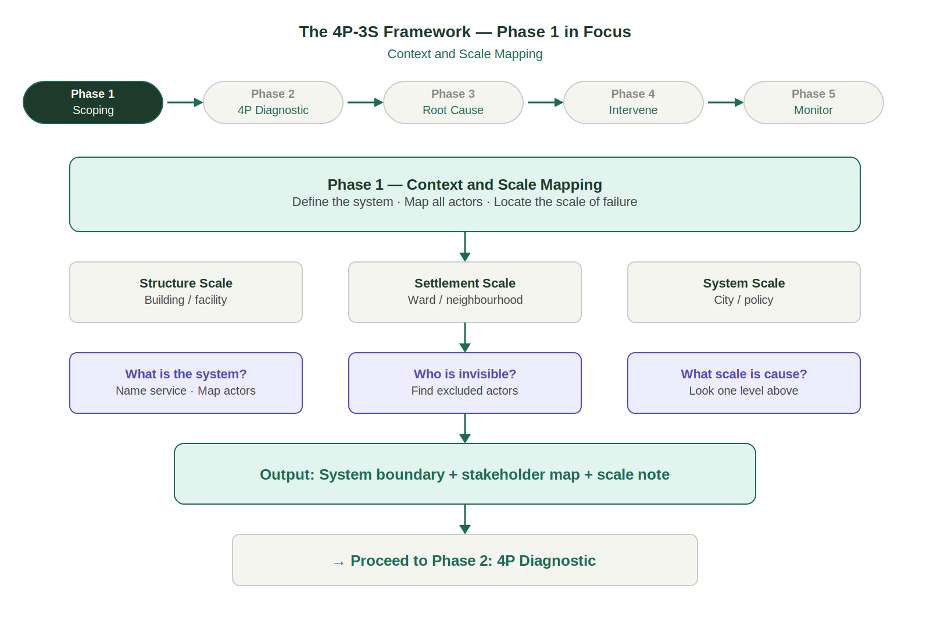
Before any intervention is designed, the system must be understood at all three scales simultaneously.
Phase 1 of the 4P-3S Framework maps the structure, settlement, and system scales, because the scale where a symptom is visible is almost never the scale where the cause sits.
The Phase in Practice
Most urban sustainability projects fail before they begin. Not because of a lack of funding or will, they fail because someone jumped to a solution before they understood the system.
I have seen this pattern repeatedly across solid waste management in cities, healthcare delivery in public hospitals, and water programmes across Indian cities. A technology platform is procured. A campaign is launched. Six months later, the bins are still overflowing, the wards still overcrowded, the water still intermittent. The intervention was not wrong. The diagnosis was.
The first thing I do on any engagement is not ask 'what is the solution?' I ask, 'What exactly is the system, and who owns it?'
Why system mapping is non-negotiable
Every urban service exists inside a web of institutions, operators, users, and invisible actors, people critically affected by the system but nowhere in its design. During my project for improving solid waste management services in a tier 1 city, informal waste pickers collected a significant share of recyclables every day. They were not in the concession agreement. They were not in the budget. They were the most critical node in the chain and the most invisible one.
The second thing Phase 1 forces you to do is locate the scale of the problem. And this is where most practitioners make their most costly mistake: assuming the scale where the symptom is visible is the scale where the cause sits.
A building where waste is not segregated is a building-scale symptom. The cause is almost always at the ward level, no accountability structure for collectors, which itself traces to city level, no enforcement mechanism in the concession agreement.
The cascade runs upward. Diagnosis must run upward with it.
Your Phase 1 roadmap, three questions before anything else
- What exactly is the system? Name the service, the governing body, the operator, and the end user. Draw a one-page map.
- At which scale is the failure visible: and which scale is one above it? Building, ward, or city. Always look at the level above the symptom before designing any intervention.
- Who is invisible? Name at least one actor category critically affected by the system but absent from its design.
This is not a desk exercise. It requires two or three days of field walks, informal conversations, and budget analysis. It is the cheapest investment in the entire engagement, and the one most often skipped.